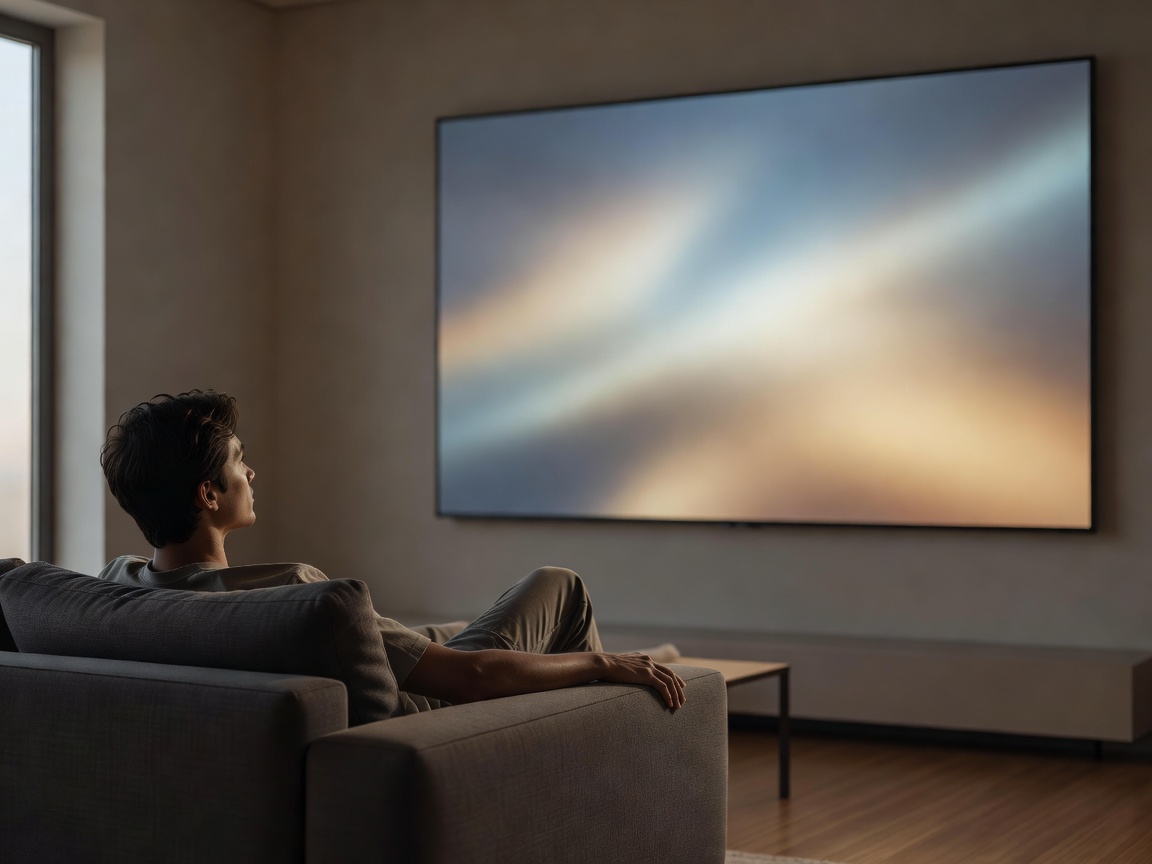
One of the most common mistakes consumers make when buying a new Smart TV is purchasing a screen that is too small for their living space. In the era of heavy Cathode Ray Tube (CRT) televisions and low-resolution broadcasts, the rule of thumb was to sit far away to avoid seeing the grainy imperfections of the image. The advent of 4K (and increasingly 8K) resolutions has completely rewritten these rules.
Today, pixels are so incredibly dense that you must sit closer, or buy a larger screen, simply to allow your eyes to resolve the fine detail you paid for. If you sit 12 feet away from a 50-inch 4K TV, your eyes physically cannot tell the difference between 1080p and 4K. Understanding the math behind viewing distances ensures you maximize your investment.
Field of View and Immersion
The goal of a modern home theater setup is immersion. To feel absorbed in a film or a video game, the screen needs to occupy a significant portion of your visual field. Organizations like the Society of Motion Picture and Television Engineers (SMPTE) and THX have studied human vision extensively to provide scientific recommendations.
For mixed usage (sports, news, casual TV), SMPTE recommends a viewing distance where the screen fills at least a 30-degree field of view. For dedicated cinematic viewing, THX recommends pushing that to a 40-degree field of view.
The Quick Calculation Method
While calculating angles can be tedious, there is a simple multiplier you can use. To achieve the cinematic 40-degree field of view, measure the distance from your seating position to the television screen in inches, and divide that number by 1.2. The resulting number is your ideal screen diagonal.
- If you sit 6 feet (72 inches) away: 72 / 1.2 = a 60-inch screen (a 55" or 65" will work nicely).
- If you sit 8 feet (96 inches) away: 96 / 1.2 = an 80-inch screen (a 77" or 85" is ideal).
- If you sit 10 feet (120 inches) away: 120 / 1.2 = a 100-inch screen (you should consider a projector or the largest TV in your budget).
Wall Mounting vs Stand Height
Screen size is only half of the placement equation; height is equally critical. Mounting a massive television high above a fireplace is one of the most common ergonomic errors in home theater design. It forces you to crane your neck upward, leading to fatigue and discomfort during long viewing sessions.
The golden rule for vertical placement is that the horizontal center-line of the screen should be roughly at eye level when you are seated in your primary viewing position. For the average couch, this places the center of the screen approximately 42 to 44 inches off the floor.
Conclusion
When in doubt between two sizes, the overwhelming consensus among home theater professionals is to go larger. It is incredibly rare for a consumer to regret buying a TV that is "too big," as human eyes quickly adjust to the larger field of view. By trusting the mathematics of 4K resolution and THX field-of-view standards, you can transform your living room into a genuinely captivating cinematic space.